Long before ‘Big Boy,’ the Crusader steamed into town
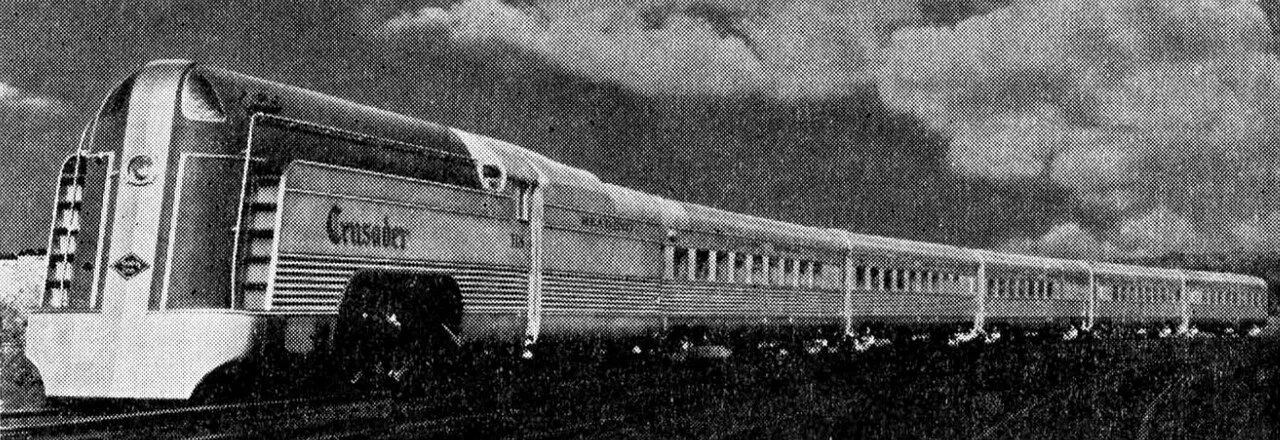
Reading Railroad’s Crusader streamlined locomotive
made its public debut in Hershey in 1937. (Wikimedia Commons)
When I think of “Big Boy,” it’s to an image of a chubby child wearing red and white checkered overalls and holding a double-decker hamburger that my mind goes.
But the Big Boy chugging its way to Pennsylvania this summer is Union Pacific’s No. 4014, the world’s largest operating steam locomotive.
It’s sure to draw big crowds as it highlights America’s 250th birthday, culminating on the Fourth of July in Philadelphia. On July 7, No. 4014 is scheduled to arrive in Lebanon, stopping at 250 N. 8th St. from 12:30 to 1:15 p.m. for public viewing,
before passing through the Hershey area.
Meanwhile, the buzz about Big Boy brings back memories of another steam locomotive that caused a sensation when it arrived in downtown Hershey in 1937.
First passenger run
“Thousands Greet Reading’s Modern Train in Hershey,” read the headline in the Hotel Hershey High-Lights newspaper from December 1937.
On Nov. 29, Reading Co.’s new art deco “streamliner” steam train, the Crusader, stopped in Hershey with more than 150 guests on board. It was the train’s first passenger trip, in advance of beginning its regular 90-mile run between Philadelphia and Jersey City, N.J.
The Edward G. Budd Manufacturing Co. of Philadelphia custom built the stainless steel beauty, painted “Reading blue,” at a cost of $500,000, or north of $11 million in today dollars.
While the passengers enjoyed lunch at the Hotel Hershey, the train continued west toward Harrisburg and the Rutherford yards for water. On the way back, it was the subject of a video shoot in the “open countryside.” (Here’s a short video of the Crusader.)
Then it was back to Hershey for an hour-long public exhibition. The train also appeared in Harrisburg and Lebanon, among other stops, in the run-up to the start of its regular operating schedule.
A brochure for the Crusader touted a list of amenities for what it called the “aristocrat of the rails.”

Insulated with heating and air-conditioning; reclining-chair cars with seats that turned to face the extra-wide windows; smoking lounges in each car (OK, that used to be a selling feature); a dining car with seating for 24, combined with a cocktail lounge for 27; an observation lounge with armchairs and reclining seats.
“It was designed and built to prove that a train can be as luxuriously comfortable as an exclusive club, without in any way impairing its utility,” the brochure read.
Alas, by the early 1960s, the struggling Reading Co. sold the stainless train set to the Canadian National Railway, which operated the cars North of the Border. For a short time afterward, Reading continued to operate the Crusader route using different equipment than the original stainless cars.
In 1983, Friends of the Railroad Museum of Pennsylvania purchased one of the Crusader’s two observation cars, which is on display in Strasburg, Lancaster County.
Only one still operating
But if it’s train history in action that you desire, you’ll want to get a glimpse of the Big Boy No. 4014.
How big is a Big Boy? At 133 feet, they are so long that their frames are hinged to negotiate turns. It’s more than half of the length of a Boeing 747 and more than three times longer than a school bus.
Union Pacific commissioned 25 Big Boy locomotives, the first of which arrived in 1941, not for luxury travel but to haul heavy equipment during World War II, according to the railroad’s website.
Only eight survive: seven are on public display around the United States, including No. 4012 at Steamtown National Historic Site in Scranton.
No. 4014 is the only Big Boy still operating.